
Susan White, Austin’s Mom
Building a Team Around Austin
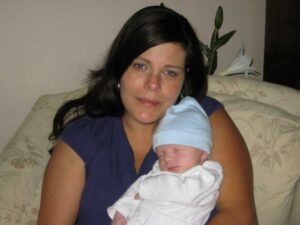
(Photo: Susan and Austin)
When Susan White talks about raising her son Austin, she speaks with honesty, determination and deep love. She also speaks about the importance of not having to do it alone.
Austin is 14 years old and lives with a rare genetic condition called Wiedemann-Steiner syndrome, as well as autism spectrum disorder. Fewer than 1,000 people worldwide are known to have the syndrome. Susan says navigating the healthcare, education and support systems has been a complex journey from the beginning.
“I’m trying to raise a child that lives in a world not made for him,” she says.
Susan first connected with Service Coordination Support (SCS) in 2017 through a referral from the Children’s Hospital of Eastern Ontario (CHEO). At the time, she and her husband were trying to coordinate services, advocate within the school system and access specialized supports for Austin’s development and feeding needs. They felt overwhelmed and exhausted trying to navigate a complex system.

(Photo of Austin)
“There were 23 people in the room,” Susan recalls of the first meeting. “The principal, CHEO, occupational therapists, physiotherapists. Everyone was there to talk about what this little boy needed.”
For Susan, SCS quickly became more than just another service provider. “SCS was a lifesaver,” she says.
Over the years, Susan worked closely with two children’s case managers who helped coordinate services, prepare documentation for funding applications, and attend meetings alongside the family.
“SCS would come to the meetings, do the notetaking, know what needed to be done, reiterate our goals, and discuss our options,” Susan says. “It was coordination of care that I could rely on and people in my corner. That was huge.”
She says one of the biggest differences was having someone who could advocate on behalf of the family.
“When SCS calls, things get done. It’s not the ‘crazy mom’ calling,” Susan says. “They fought battles when I couldn’t as a mom. There was empathy. That’s the most important thing.”
Today, Austin’s needs continue to evolve as he prepares for high school. Susan says having SCS involved helps ensure the people around him understand the full picture — emotionally, physically and developmentally.

(Photo of Austin)
“SCS holds weight,” she says. “They’re one of the tools in my backpack. The continuity, collaboration, and coordination with CHEO and others make me feel powerful because I have a team behind me.”
Susan describes consistency and compassion as two of the organization’s greatest strengths.
“Having staff that care, and are allowed to love their clients, that matters,” she says.
She also credits SCS with helping her think about Austin’s future in a bigger way, not just day-to-day support, but long-term planning and stability. Looking back, Susan says she wants other families to know they do not have to navigate the system on their own.
“One thing needs to tie everything together, and that’s what SCS does,” she says. “I can’t imagine my life, or Austin’s life, without SCS. I want other families to have the support I have.”